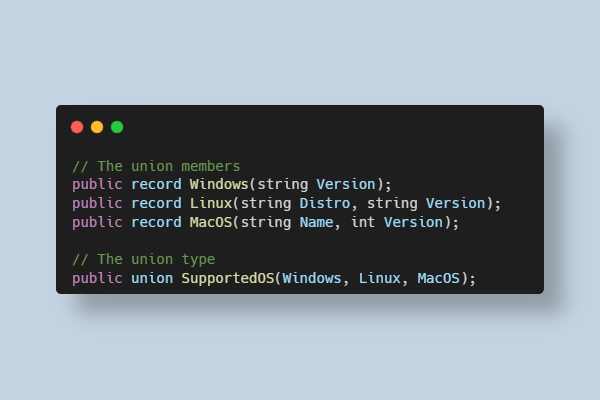
C# Gets Union Types
- C# introduces union types for better performance and compatibility
- Developers can now define union types when interfacing with other languages
- This feature brings C# closer to C-like performance in certain scenarios
The Buzz Score
The Internet’s Verdict: 70% Hyped, 30% Skeptical
Community Reaction
Developers are excited about the introduction of union types in C#.
I love C# and in every iteration we’re getting more and more features to get C-like performance in a lot of scenarios. C# does it really well because if your problem isn’t performance/memory-constrained, you can ignore these features and fallback on the language’s natural ease of use.
However, some developers are skeptical about the syntax.
I wish the syntax looked more like typescript. This will confuse my eyes for a while.
Impact on Interoperability
The introduction of union types will improve C#’s interoperability with other languages.
I’m glad to finally see this making it’s way into C#. Not so much because I want to use unions purely in C#. But because I want to be able to define them when interfacing with other languages.
Some developers note that F# has had similar features for a while.
F# leads the way and C# slowly catches up, as always. Yet for some reason, C# still gets all the mindshare.
Focus Keyword: C# Union Types